MLOps Platform
Enterprise Machine Learning Operations (MLOps) and AI Data Governance platform. Streamlining end-to-end model lifecycle management from automated ETL feature stores and distributed model training to automated CI/CD model deployment, real-time drift monitoring, and compliance data lineage tracking.
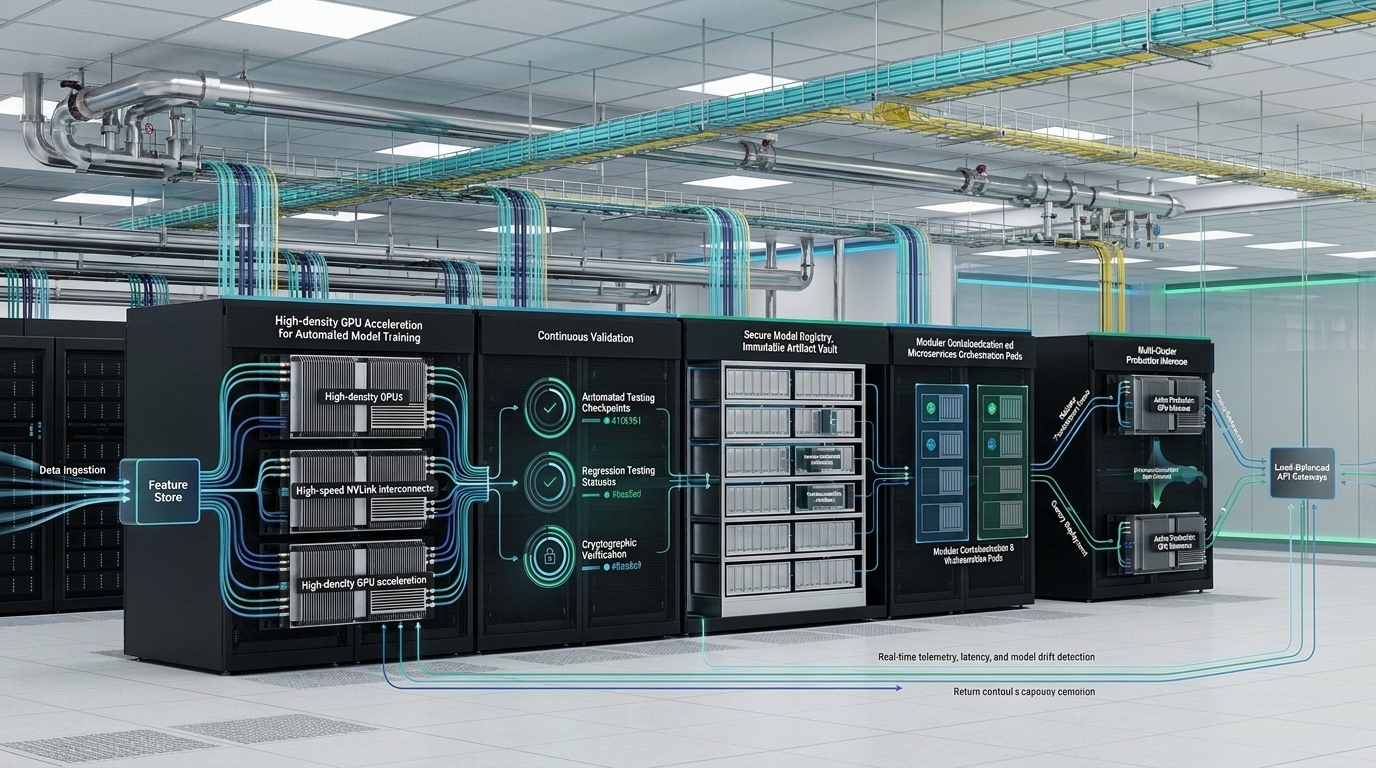
Automated CI/CD Model Pipelines
Automate machine learning workflows from code commit to production API deployment. Built on Kubeflow, MLflow, and Airflow orchestrators, our MLOps platform automates data ingestion, hyperparameter tuning, model artifact versioning, and zero-downtime blue/green API deployments across Kubernetes clusters.
- check_circle Automated DAG Workflows linking data ETL, training scripts, and model validation tests.
- check_circle Centralized Model Registry with cryptographic artifact signing and approval gates.
- check_circle Canary & Shadow Deployments for low-risk validation of new AI model weights.

Centralized Feature Store & Data Lineage
Eliminate training-serving skew and redundant feature engineering across data science teams. Our centralized Feature Store manages batch historical features for model training alongside low-latency sub-millisecond online key-value stores for production inference, enforcing full data lineage tracking for regulatory audits.
- check_circle Dual Online/Offline Feature Sync ensuring training datasets match inference payloads 100%.
- check_circle Automated Data Quality Checks blocking corrupted or missing feature inputs before inference.
- check_circle Immutable Data Lineage Graph tracking raw data source to trained model weights.
Real-Time Drift Monitoring & XAI Compliance
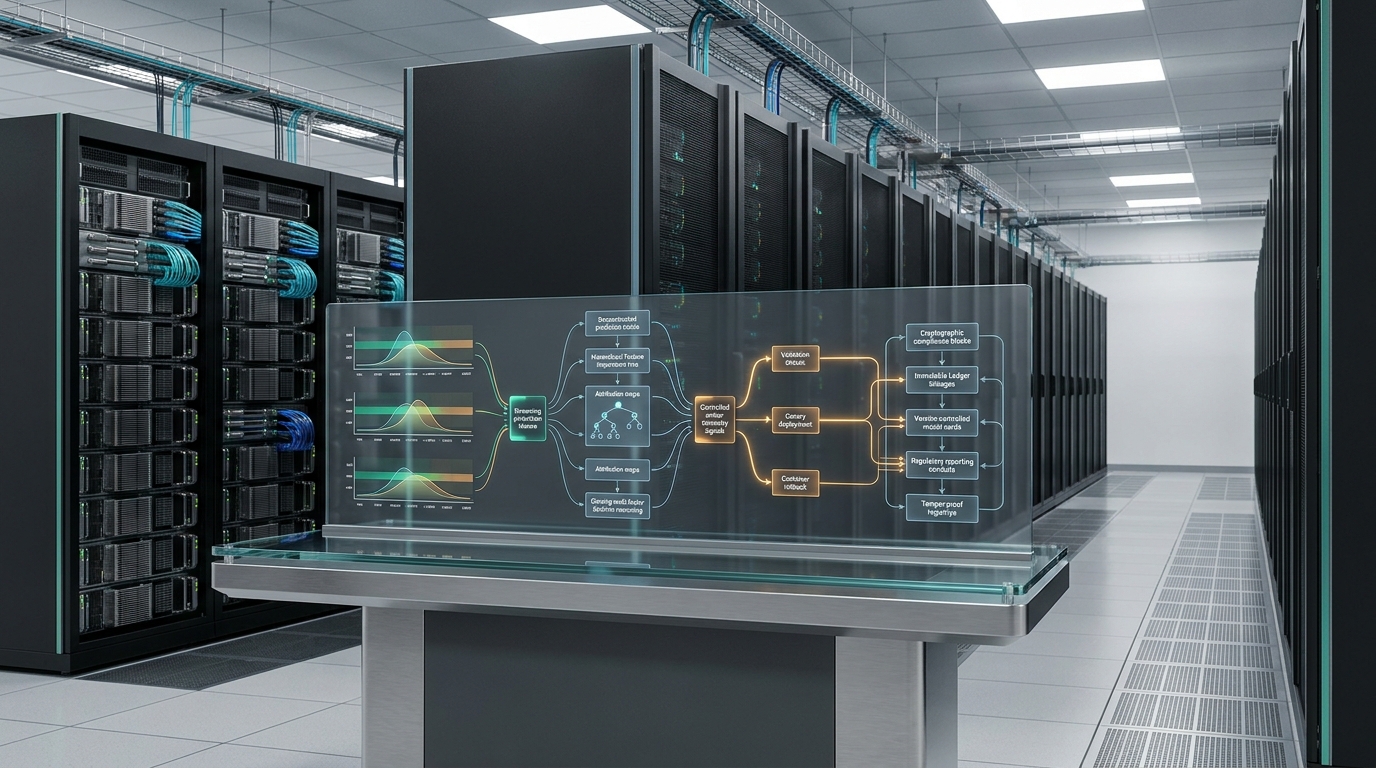
Detect model performance degradation before business impact occurs. Continuous telemetry monitors concept drift, data distribution shift, and API latency in real time. When drift exceeds statistical thresholds, automated triggers launch re-training pipelines while SHAP and LIME Explainable AI (XAI) frameworks provide transparent model decision auditing.
- check_circle Statistical Data & Concept Drift Detection triggering automated model retraining loops.
- check_circle Explainable AI (SHAP & LIME) generating human-understandable decision attribution reports.
- check_circle Model Fairness & Bias Auditing verifying compliance with banking and healthcare regulations.
Engineering Specifications Matrix
| Pipeline Orchestration | Kubeflow Pipelines, Apache Airflow, MLflow, Tekton, Argo Workflows Integration |
|---|---|
| Feature Store Engine | Feast / Hopsworks Enterprise (Offline Parquet/Delta Lake + Online Redis/Cassandra) |
| Model Registry | Cryptographically Signed Artifact Store (S3/GCS) with MLflow / Weights & Biases Metadata |
| Serving Architecture | Triton Inference Server, KServe, vLLM, TorchServe (Autoscaling Kubernetes Pods with GPU Sharing) |
| Drift & Telemetry | Evidently AI / Whylogs Integration + Prometheus/Grafana Dashboards (KS Test, PSI, Wasserstein Distance) |
| Compliance & Governance | SHAP / LIME Feature Attribution, Model Cards, Immutable Audit Logs, Role-Based Access (RBAC) |
| Deployment Integration | Multi-Cloud (AWS EKS, Azure AKS, GCP GKE) & On-Premise Bare-Metal Kubernetes Clusters |
Featured MLOps Software Modules & Services
MLOps Core platform licenses, Feature Store engines, real-time telemetry modules, and deployment services.

MLOps Core Platform
Includes Kubeflow/MLflow workflow engine, versioned model registry, RBAC security, and CI/CD deployment pipelines.

Enterprise Feature Store
Dual batch and sub-millisecond online feature store, automated data validation, and lineage cataloging.

Model Drift Telemetry Engine
Real-time statistical drift monitoring, automated retraining triggers, and SHAP explainable AI compliance reporting.

MLOps Deployment Package
Includes Kubernetes cluster setup, Triton/KServe inference deployment, pipeline template creation, and 24/7 support SLA.
Frequently Asked Questions
Technical answers regarding MLOps vs. traditional DevOps, Feature Store online/offline synchronization, concept drift auto-retraining, Explainable AI (XAI) compliance, and Kubernetes serving scalability.
Streamline Your Enterprise AI Lifecycle with MLOps
Get a custom MLOps architecture review, feature store demo, and BOQ quote from Microlines AI engineers.
Request Solution Proposal
Get custom BOQ pricing and architectural support from Microlines engineers.